Rhône
Major Alpine river flowing through Switzerland and France to the Mediterranean.

Txllxt TxllxT · CC BY-SA 4.0
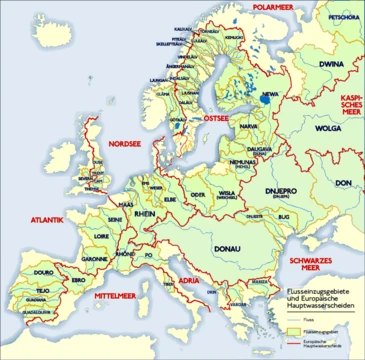
The Rhône is a major river in France and Switzerland, rising in the Alps and flowing west and south through Lake Geneva and Southeastern France before discharging into the Mediterranean Sea. It is one of the three Mediterranean rivers with the largest water discharge, alongside the Po and the Ebro. The river's source is the Rhône Glacier in the Swiss canton of Valais, part of the Lepontine Alps.
- Length
- 330 km navigable from Lyon to sea (Class V waterway)
Lore & Background
The Rhône begins as meltwater from the Rhône Glacier at about 2,208 meters altitude in the Swiss Alps. It flows southwest through the Goms valley, past Brig where it receives the Massa from the Aletsch Glacier, and then the Vispa at Visp. Between Brig and Martigny, it collects waters from the Pennine Alps, Bernese Alps, and Mont Blanc massif. At Martigny, it turns northwest toward Lake Geneva, then enters the lake near Le Bouveret. The lake ends at Geneva, where the Le Seujet dam controls the outflow. Below the dam, the Rhône receives the Arve, fed by Mont Blanc, with higher sediment and lower temperature. From Lyon it flows south, joined by the Isère, Drôme, Durance, and others, before dividing at Arles into the Grand Rhône and Petit Rhône, forming the Camargue delta.
Reader's Guide
The Rhône has been an important highway since Greek and Roman times, serving as the main trade route from the Mediterranean to east-central Gaul. It helped convey Greek cultural influences to the Hallstatt and La Tène cultures. Celtic tribes such as the Seduni, Sequani, and Allobroges lived near its banks. Navigation was historically difficult due to fierce currents, shallows, floods, and droughts. Until the 19th century, passengers traveled in coches d'eau drawn by men or horses, often with a painted cross for protection. Trade on the upper river used barques du Rhône, sailing barges of 75-tonne capacity, hauled upstream by 50 to 80 horses. Today, the Rhône is a Class V waterway from Lyon to the sea, with 12 locks operated from a central control at Châteauneuf. The river's strong current can reach 10 km/h, especially below the last lock at Vallabrègues. The Saône connects the Rhône to the Seine, Marne, Moselle, and Rhine via canals. The Rhône Valley is the driest and largest wine region of Switzerland, sheltered by the Alps.
Did You Know?
- The Rhône is one of the three Mediterranean rivers with the largest water discharge, along with the Po and the Ebro.
- The river's source is the Rhône Glacier, part of the Lepontine Alps, while the Saint-Gotthard Massif gives rise to the Reuss, Rhine, and Ticino.
- At Arles, the Rhône divides into the Grand Rhône and Petit Rhône, forming the Camargue delta.
- The Rhône has a strong current that can reach speeds up to 10 km/h, particularly below the last lock at Vallabrègues.
From Alpine Ice to Mediterranean Delta
The Rhône's story starts at roughly 2,208 metres, where meltwater trickles from the Rhône Glacier on the eastern edge of Valais. That glacier belongs to the Saint-Gotthard Massif, the same geological formation that also gives birth to the Reuss, the Rhine, and the Ticino. In its first kilometres past Gletsch and the Goms, the water is barely a torrent. Yet by the time it reaches Brig, where it absorbs the Massa from the Aletsch—the Alps' longest glacier—and shortly after the Vispa, Valais's longest tributary, it has become a powerful mountain river. The valley runs westerly to Leuk, then southwest some fifty kilometres to Martigny, where the Drance pours in from the left bank and the river makes a sharp northward turn. It then threads a narrowing valley near Saint-Maurice, a corridor long prized for controlling Alpine passes, before entering Lake Geneva. Below Geneva's Le Seujet dam it takes on the cold, sediment-rich Arve, and from there it sweeps west and south through southeastern France. At Arles it divides into the Grand Rhône and the Petit Rhône, whose braided delta gives rise to the Camargue before the water reaches the Gulf of Lion.
A Name Carried Across Millennia
The name Rhône is a linguistic fossil stretching back to Proto-Indo-European. Its reconstructed Gaulish form, *Rodonos or *Rotonos, derives from the PIE root *ret-, meaning "to run" or "to roll," a morpheme that surfaces in river names across Europe. That root passed into Latin as Rhodanus and into Greek as Rhodanós, where it was already well established in classical geography. From those classical forms the name radiated into a remarkable spread of modern tongues: French le Rhône, Occitan Ròse, Arpitan Rôno, German Rhone, Italian Rodano, Walser Rotten, and Romansh Rodan. Gender assignments shifted along the way. The original Gaulish and Latin forms were masculine, a convention preserved in French, Spanish (el Ródano), Portuguese, and Italian (il Rodano). German, however, borrowed the French name but assigned it the feminine die Rhone, while the older masculine der Rotten survives only in the Upper Valais dialect as Rottu. In French the river also yields the adjective rhodanien, as in le sillon rhodanien, the name for the long, straight valley corridor of the Saône and Rhône that cuts due south between the Alps and the Massif Central.
A Waterway Forged for Commerce
Long before railroads and highways reshaped European logistics, the Rhône served as a critical inland artery linking Arles, Avignon, Valence, Vienne, and Lyon to Mediterranean ports at Fos-sur-Mer, Marseille, and Sète. A barge journey downstream once consumed three full weeks; today a motorized vessel covers the same distance in about three days. The river is classified as a Class V waterway for the 325-kilometre stretch from the Saône's mouth at Lyon to Port-Saint-Louis-du-Rhône, while an additional 149 kilometres upstream were made navigable for smaller craft as far as Seyssel—though the section between Lyon and Sault-Brénaz has been closed to navigation since at least 2017. Twelve locks, centrally operated from a single control centre at Châteauneuf, run daily from five in the morning to nine in the evening, with commercial barges permitted to pass at night by special authorisation. The current can reach ten kilometres per hour during high water, a hazard most acute below the last lock at Vallabrègues and in the narrow first diversion canal south of Lyon. Beyond the main channel, a web of canals—the Centre-Loire-Briare, the Loing, the Marne-to-Saône, the Vosges, and the Rhône-to-Rhine—connects the river to the Seine, the Marne, the Moselle, and the Rhine, weaving it into a vast continental waterway network.
Hydrological Weight and the Camargue
Few rivers carry as much hydrological significance relative to their basin as the Rhône. Alongside the Po and the Nile, it ranks as one of only three Mediterranean rivers with the largest water discharge, a distinction that underscores its role in shaping the ecology and climate of the western Mediterranean basin. The river's source, the Rhône Glacier, sits at the eastern edge of Valais within the Saint-Gotthard Massif—a single geological structure that also spawns the Reuss, the Rhine, and the Ticino, making the area a rare convergence point for four major European waterways. The Rhône's journey from that high-altitude glacier, through the sheltered Valais valley where three of the highest Alpine ranges create the country's driest and largest wine region, across Lake Geneva, and down through southeastern France, ultimately delivers its enormous volume to the Gulf of Lion. At Arles, near the mouth, the river splits into the Grand Rhône and the Petit Rhône, and the resulting delta forms the Camargue, a vast wetland region whose very existence depends on the river's persistent flow.
Gallery
Frequently Asked Questions
What is the Rhône?
The Rhône is a major Alpine river that starts in the Swiss Alps, threads through Lake Geneva and southeastern France, and ultimately empties into the Mediterranean Sea. It ranks as one of only three Mediterranean rivers with the highest water discharge, the others being the Po and the Ebro.
Where does the Rhône begin?
The river is born at the Rhône Glacier in the Swiss canton of Valais, part of the Lepontine Alps. From that high-altitude source it flows west and south, passing through Lake Geneva before entering France.
How far can you navigate the Rhône?
The Rhône is navigable for roughly 330 kilometers, running from Lyon all the way down to the Mediterranean coast. That entire stretch is designated as a Class V waterway.
Which countries does the Rhône cross?
The Rhône flows through two nations: it originates in Switzerland and then enters France, where it continues its journey to the Mediterranean. It serves as a key waterway linking the Alpine interior to the Mediterranean littoral.
Why is the Rhône considered so significant?
Its position as one of the three highest-discharge rivers feeding the Mediterranean makes it a vital natural waterway for both Switzerland and France. The long navigable corridor from Lyon to the sea also underpins major commercial and transport activity along the route.
More in Rivers Of Europe 1-19
Spotted an error? Know more?
This is a living reference — every entry is fact-audited, and reader corrections feed straight into our audit queue. Suggest an edit · See this site's audit record